Educational Guide · Wasatch Front Homeowners
Utah's Hard Water Problem: What It Is and What to Do About It
Utah consistently ranks among the top states for water hardness. Here's what that means for your home, your appliances, your skin, and your water bill — and what actually works to fix it.
Why Is Utah's Water So Hard?
The Wasatch Front sits above geology that is unusually rich in carbonate rock — limestone, dolomite, and calcium-bearing formations that were deposited over millions of years as ancient inland seas. When snowmelt and precipitation filters through these formations on the way to the Wasatch watershed, it dissolves calcium and magnesium, arriving at your tap heavily laden with minerals.
The Great Basin's closed drainage system compounds this effect. Unlike rivers that drain to the ocean and carry minerals away, Utah's interior basin concentrates dissolved minerals over time. The Great Salt Lake — essentially a giant evaporation pond — is the visible result of this process operating at landscape scale.
The result for Wasatch Front homeowners: water that is classified as "hard" to "very hard" across virtually all municipal water systems, with some communities — particularly in Davis County and southern Utah County — reaching levels that are among the highest in the United States.
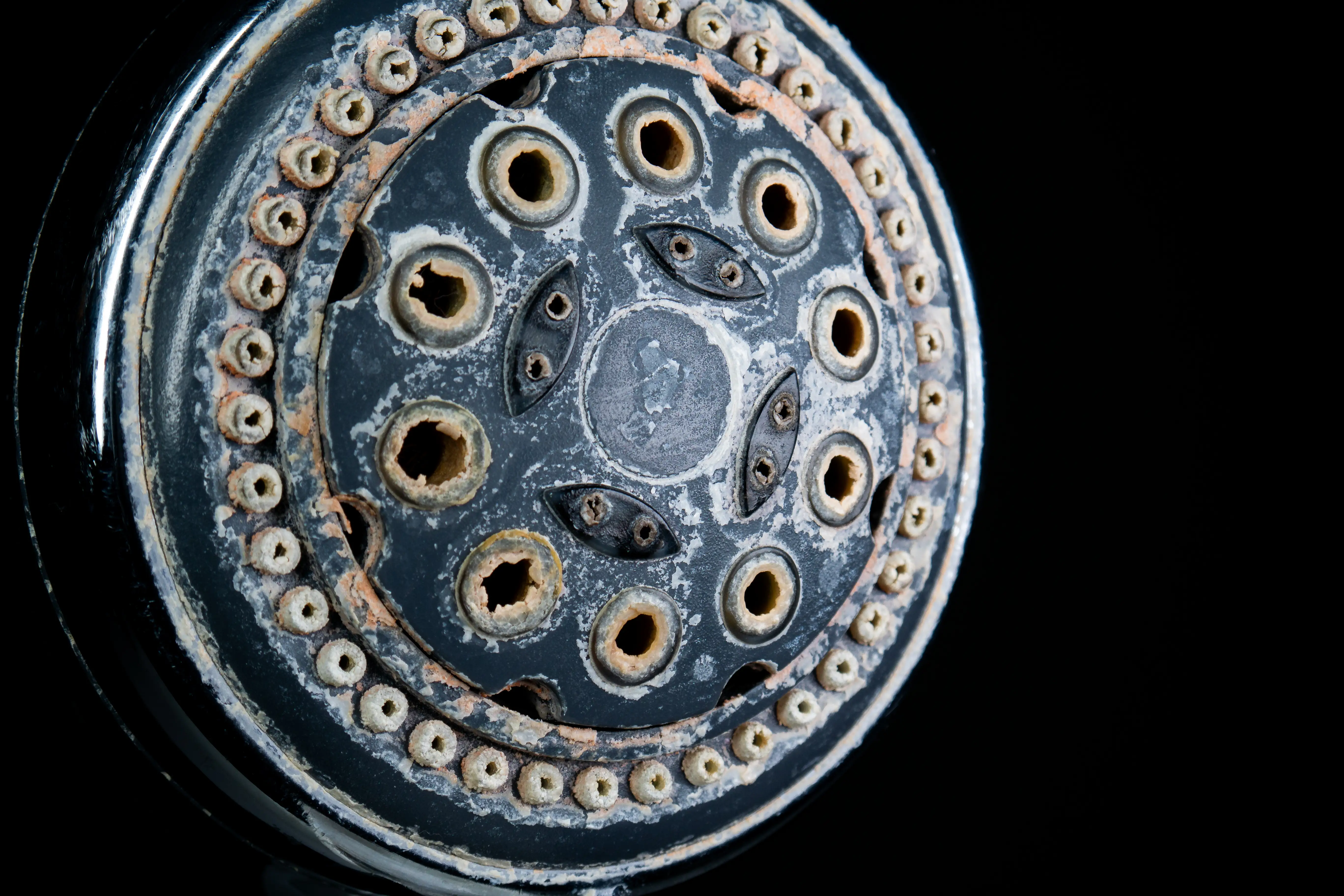
Calcium scale deposits on a Utah showerhead — a direct result of hard water mineral buildup.
The Water Hardness Scale
| Classification | GPG | mg/L | What it means at home |
|---|---|---|---|
| Soft | 0–3 | 0–51 | No scale, excellent soap lathering |
| Slightly Hard | 3–7 | 51–120 | Minor spotting, minimal scale |
| Moderately Hard | 7–10 | 120–180 | Noticeable scale in hot water systems |
| Hard | 10–14 | 180–250 | Visible deposits, appliance efficiency loss begins |
| Very Hard | 14+ | 250+ | Heavy scaling, shortened appliance life, dry skin common |
Classifications per the Water Quality Association. Most Wasatch Front cities fall in the Hard or Very Hard categories.
Water Hardness by Wasatch Front City
Water hardness levels vary by city, neighborhood, and season as utilities blend different sources. These figures reflect typical ranges from utility consumer confidence reports and third-party water quality data. Your specific home may vary.
| City | GPG (typical) | mg/L (typical) |
|---|---|---|
| Bountiful | 18–38 | 300–513 |
| Spanish Fork | ~25 | ~427 |
| Springville | ~23 | ~393 |
| Draper | ~21 | ~357 |
| Layton | ~21 | ~352 |
| Sandy | ~18 | ~308 |
| Orem | ~18 | ~301 |
| American Fork | ~15 | ~257 |
| Salt Lake City | ~12 | ~210 |
| Lehi | ~11–16 | ~200–275 |
| Ogden | ~10–28 | ~170–480 |
| Provo | ~9–15 | ~164–257 |
Sources: Utility consumer confidence reports, pipeprosutah.com, JVWCD water quality data, and third-party water quality aggregators. Hardness can vary significantly by neighborhood, season, and active source. A Blue Logic free in-home water test measures your specific tap.
What Hard Water Actually Does to a Utah Home
The effects are visible, measurable, and expensive — but they build gradually enough that most homeowners don't realize how much it's costing them.
Water Heater Efficiency Loss
Hard water scale acts as an insulator inside your water heater tank. The WQA has documented efficiency losses of 24–48% in hard water areas — meaning your heater burns significantly more gas or electricity to produce the same hot water. In Utah's very hard water regions (above 14 GPG), scale accumulation is rapid. Tank water heaters in untreated Wasatch Front homes often fail 5–7 years earlier than their rated lifespan.
Fixture and Faucet Scale
The white, chalky deposits on your faucets, showerheads, and glass shower doors are calcium carbonate — the same substance in limestone. Every time water evaporates from a surface, the dissolved minerals are left behind. In Utah's hardest water communities, showerhead flow can be measurably reduced within months of installation. These deposits are abrasive and difficult to remove without acid-based cleaners.
Dishwasher and Appliance Damage
Dishwashers expose hard water to high heat repeatedly — ideal conditions for scale formation. The spray arms, heating elements, and internal pipes of dishwashers in untreated Utah homes accumulate scale that reduces cleaning effectiveness and shortens the appliance's life. Similar effects occur in washing machines, ice makers, coffee makers, and any appliance that heats water.
Skin, Hair, and Laundry
Hard water minerals interfere with soap and shampoo lathering, leaving a residue that doesn't fully rinse away. Many people in hard water areas notice their skin feels drier after bathing and their hair feels coated or difficult to manage. Laundry washed in hard water requires more detergent, comes out stiffer, and fades more quickly than laundry washed in softened water.
What Actually Fixes Hard Water in a Utah Home
Three options — each with a different scope, price point, and level of protection.
Traditional Salt-Based Water Softener
A traditional softener uses ion exchange to swap calcium and magnesium ions for sodium ions, effectively removing hardness from your water. It works well for scale prevention and is the simplest approach to hard water.
- ✓ Scale buildup
- ✓ Appliance protection
- ✓ Spotty dishes and fixtures
- ✗ Chlorine / chloramines
- ✗ Arsenic, PFAS, heavy metals
- ✗ Taste and odor improvement
Blue Logic Whole-Home Filtration (Recommended for most Utah homes)
Blue Logic's 7-layer media system includes advanced water softening (using approximately 75% less salt than a traditional softener) PLUS filtration for chlorine, chloramines, iron, manganese, and more. Includes a free under-sink RO for kitchen drinking water with purchase.
- ✓ Scale and hardness
- ✓ Chlorine and chloramines
- ✓ Iron and manganese
- ✓ Arsenic reduction (7-layer media)
- ✓ Taste and odor
- ✓ Appliance protection
- ~ Partial PFAS reduction
- ✗ Full dissolved solids removal
Blue Logic Whole-Home Purification (RO)
Everything in the filtration system plus a commercial-grade reverse osmosis membrane, pressurized storage tank (up to 250 gallons), and delivery pump. RO works at the molecular level — addressing what filtration alone cannot reach, including arsenic and heavy metals at every tap.
- ✓ Everything in filtration
- ✓ Arsenic (molecular removal)
- ✓ PFAS and heavy metals
- ✓ Pure water at every tap
- → High contaminant concern areas
- → Health-focused households
- → Replacing bottled water
Not Sure Which Option Fits Your Water?
A Blue Logic specialist comes to your home, tests your hardness and chlorine on the spot, and walks you through your specific options — no cost, no obligation.
Schedule Free Water Test →Common Questions About Utah Hard Water
What makes Utah water so hard compared to other states?
What hardness level is considered 'hard' or 'very hard'?
Does hard water make you sick?
How does hard water damage appliances?
Will a water softener fix all my hard water problems?
Get Your Water Tested — Free
Blue Logic tests your home's hardness on-site and recommends the right solution for your specific water and home. No cost, no obligation.
Know Your Water. Protect Your Home.
Schedule a consultation with our team
Prefer to talk now? Call or text (801) 980-2583